
I love Ampeg amps! Their vintage models that were so different compared to the most standard brands but also their modern amps that tend to bring the vintage aesthetics with more output power. The Ampeg V4BH is still one of my favourites but require something extra. So let’s talk about that!

Ampeg, known for their innovative amp designs and big and heavy bass amplifiers from the past (the SVT), brought out the full tube V4BH amp (sometimes called the V4-B Classic Series) in the late 90’s as a way to get the legendary tone of the known Ampeg SVT from a lower powered amp. Therefore the amp was designed to share the preamp with the known SVT topology (the V4BH has only one preamp though) but was made to work with four 6L6 tubes delivering 100W output power. By lowering this wattage the amp could be pushed more delivering output-power-overdrive and natural compression. The manual can be found here.

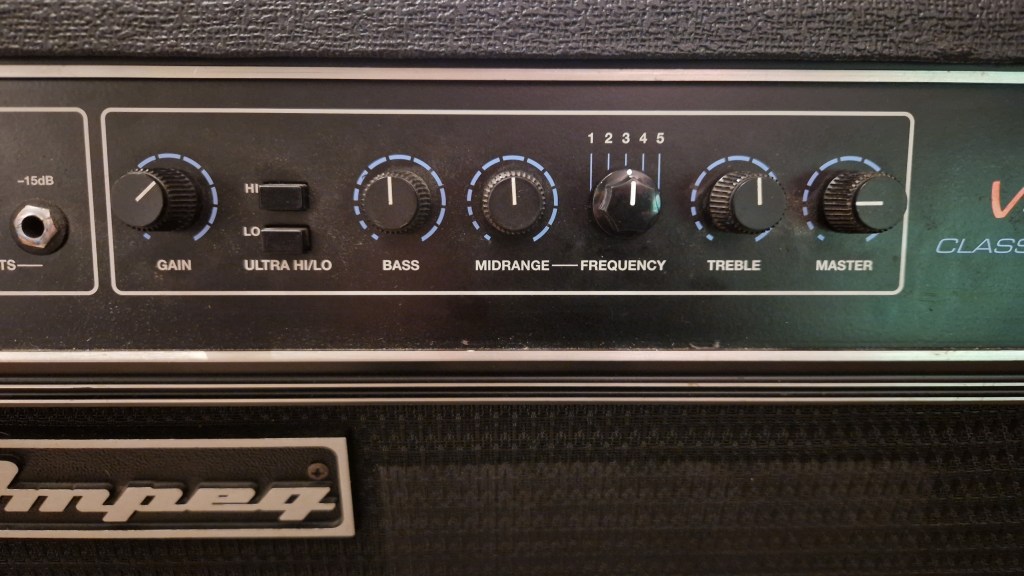


Although Ampeg never released a statement that this amp was a reissue of the legendary Ampeg V4-B amp it can easily be seen as one. Circuitwise this amp is closer to a SVT then the V4. Ampeg released a real V4-B reissue in 2013 that also shares the same aesthetics of the vintage amp.
The circuit
The amp is lightweight compared to the other known Ampeg models. The sleek black and white aesthetics fit the Ampeg brand well making it quite recognisable. Multiple versions of this model were released. This version, with the Red – Blue logo was the second version that came out. All models were made from the same schematic.
The amplifier has controls for volume (‘Gain’ and ‘Master volume’) and EQ (‘Treble’ / ‘Midrange’ / ‘Bass’); the specific Midrange (‘Frequency’) can be altered by a knob making the Midrange knob focus around certain frequencies. Input(s) are in the front of the amp giving the option to use a non-attenuated or attenuated input. On the back are two speaker outputs that can be switched from 4 to 8 ohms; the ‘Main’ output is grounded and should be used first when connecting a cabinet. An FX loop is available (‘Preamp Out’ / ‘Poweramp in’) and a slave output (located after the FX loop) can be used to power a second (power) amp. A ‘Presence’ button is available to add some high end roll off in the power amp section.
Ampeg has the schematic available on their website
As you can see the preamp follows the basic setup of a single vintage SVT preamp which is then followed by a phase inverter / poweramp design that is very similar to the SVT. The original SVT phase inverter / poweramp used a combination of a 12DW7 (combination of 1/2 a 12AX7 and 1/2 a 12AU7) and a 12BH7 (12AU7 but much more heavy duty). As these tubes get rarer (although they are reissued by JJ) Ampeg looked for a way to work around these tubes. The Ampeg V4-BH and the (later released) Ampeg SVT-CL both use the 12AX7 / 12AU7 combination in the phase inverter / poweramp stage to mimic the design of a vintage SVT.


The mods
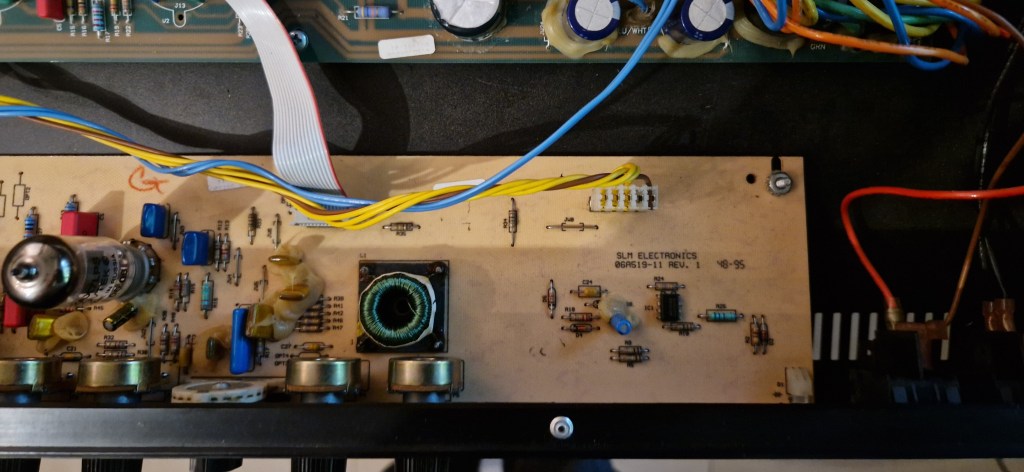
- Set the voltage according to what’s available. This amp has the ability to use multiple input AC voltages, yet I often see the stock setting being used (from the 90’s). I set mine to 240V to make the heaters run on exactly 6.3V AC.
- The output transformer has an unused tap for a 16 ohm output. As all transformer connections are done with special sockets / plugs you can easily swap one out for 16 ohms.
- The power tubes are ‘protected’ with four fuses (250mA, T, 250V). These fuses can easily be replaced with four 1 ohm resistors giving you the option to measure the BIAS of the amp and set the trimpot.
- For a ‘real’ SVT push you can replace the first 12AX7 in the phase inverter with a 12DW7. To make this work it is advised to replace the cathode and anode resistors (R17 and R18) with a smaller value as designed in the schematic of the SVT. With this change you can also add the ‘Balance’ control to balance out the phase inverter.
Volume issues;
But there is another issue; reading upon this amp a lot of people claim that the perceived output of this amp is not what is advertised for. They claim the amp is too low of volume and sound cold, sterile or less dynamic compared to it’s bigger brother(s). I can partially agree on that: it lacks that certain ‘push’ but I’ve never had an instance on which I had too little volume (except for some outdoor gigs). Looking at the schematics two points catch my interest:
DISCLAIMER: as I am not a professional I can only guess why the described values were used. There is a possibility that Ampeg decided on these values to make the amp more stable. I tried reaching out to Ampeg but I got no reply on my messages. Please try these mods on your own risk; I don’t take responsibility if these mods will alter or damage your amp.
DISCLAIMER 2: These mods need to be done by someone who knows how to deal with the high voltages inside a tube amp. Working with tube amps can kill you! Please be careful, drain your caps and always know what you are doing. Are you in doubt? Please contact a professional!
- R9 mod:
On the input of the phase inverter we find R9, a 10k resistor in line with the audio that is followed by a resistor to ground (OPT10, 470k) going into the first 12AX7 stage. In the vintage SVT schematics we can find that the value of this resistor is 1k and is followed by 2 small signal diodes. These diodes were omitted in the first Ampeg SVT-CL amps but were later advised to be added afterwards to ‘clamp the incoming signal’; these diodes act as a limiter preventing the poweramp to overload (check here / page 11). These two resistors act like a voltage divider (like a potmeter) and will interfere with the volume going into the phase inverter.
In my unit OPT10 was not placed (that’s why it’s called OPT / it’s optional). After I changed R9 to 1k, added a 470k to ground (and the two clamping diodes) I heard little change in volume but also in how the amp sounded. Adding a resistor to ground on the input of the phase inverter though stabilises this tube; I would recommend adding it to the amp. - The NFBL mod:
A negative feedback loop (NFBL) is a part of the circuit that feeds the output of the poweramp back into the phase inverter and hereby changing the EQ and the dynamics of the amp. An amp without a NFBL (like a Vox AC30) is a very dynamic amp that has a very mid focused EQ. Amps with a NFBL (like most Fender amps) tend to sound more flat in their EQ (equal emphasis on bass, mids and highs) but lose some of that extreme dynamics.
The amount of the NFBL is regulated with two resistors: one in line with the NFBL and one to ground. Their ratio determines how much signal is fed back into the phase inverter. Too much feedback results in compressed sounds, a lower output volume and an emphasis on the low end / low mids. Too little feedback results in more dynamics, more volume and in more emphasis on the higher mid frequencies.
Looking at the schematics we can see that the NFBL on the Ampeg V4-BH is set by resistors R11 (15k) and R13 (220R). As the NFBL is connected to the 8 ohm tap of the output transformer and the amp is 100W, we can calculate that the feedback voltage is approx 0.41V.
Looking at the vintage Ampeg SVT (47k in line, 220R to ground, 4 ohm transformer tap and 300W amp) we can calculate the feedback voltage to 0.16V.
These values make it clear that the Ampeg V4-BH receives much more feedback compared to it’s bigger brother, the SVT. I don’t know if this was a deliberate choice by Ampeg (more compression / less output volume = cleaner amp) or that they miscalculated this value (going from a 300W amp to a 100W amp (300:100 = 3) you could calculate the new value of the feedback resistor by dividing it by 3 (47k : 3 = 15k); this would be an OK value if the tap on the transformer was equal but both amps use different taps!).
I changed this value in my amp by adding a 22k resistor in series with the 15k making it approx 38k (which is the advised value for an amp like the V4-BH).
I’ve done these mods to my amp. I recorded three samples to check if the volume did increase (looped bass line => Ampeg V4-BH => OX top amp box => LUNA).
These samples will be available later
OK, maybe it’s hard to hear a difference so I checked the size of the waveform in my recording software. After the NFBL mod the output volume increased big time! The next few gigs will be used to check if the amp still functions correctly or that it became unstable. I’ll keep you updated!
Edit 03-07-2026: I’ve used this amp now on a couple of gigs under some extreme conditions. The amp worked flawlessly and sounded amazing! Really happy with it!
The sounds
This amp is simply awesome! I have a certain love of old Ampeg amps and do own a SVT and a vintage V4-B, yet this amp does something special to the mix. It is cleaner, neater, more focused then my V4, it has the feeling of a SVT but the restriction to 100W makes it a beast in both studio and live settings. It takes pedals well and the extra FX loop makes it very versatile on both bass and guitar! I love it!
Links


Leave a comment