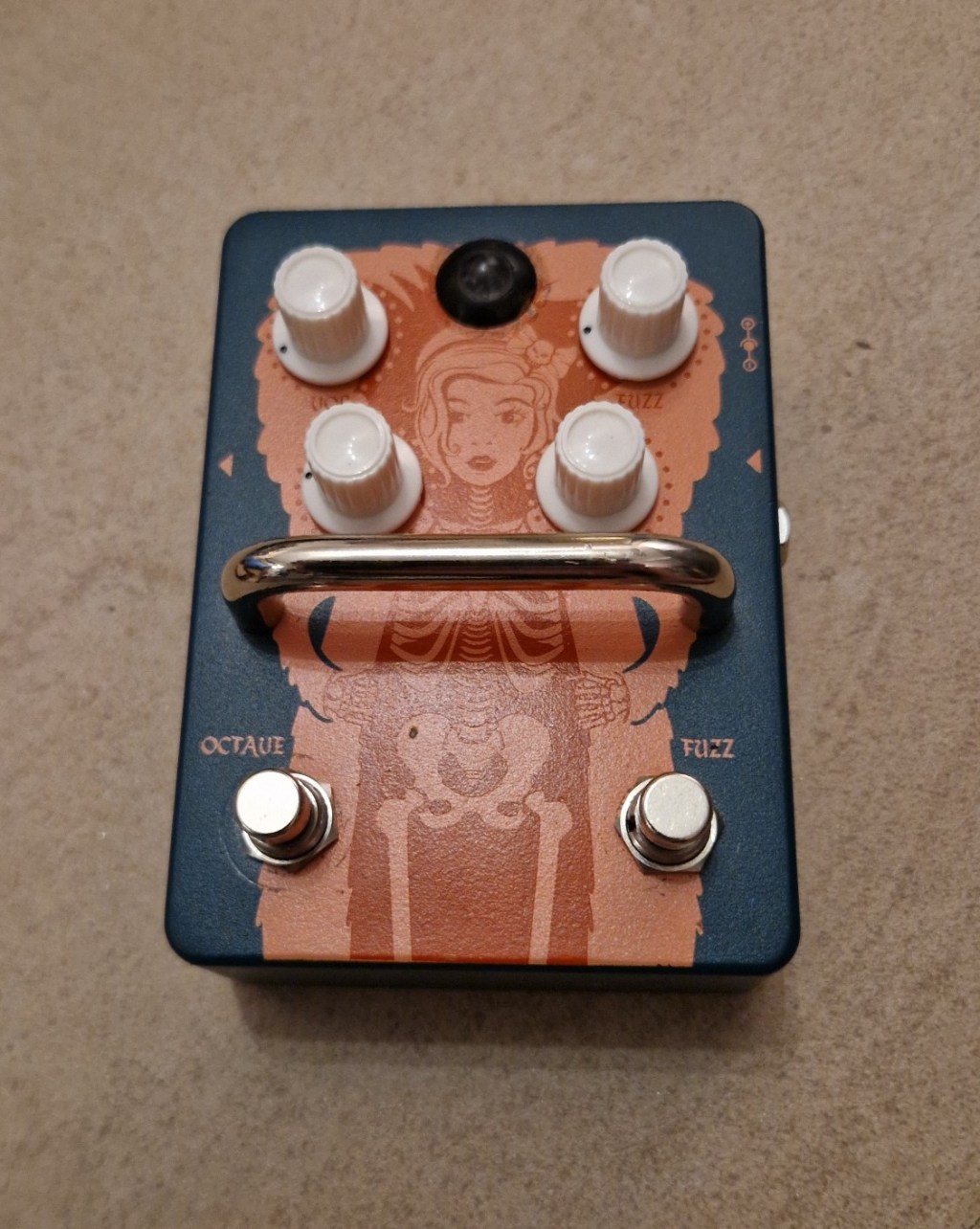
I recently got this pedal in as I wanted to know if this pedal shines on a bass. I was really surprised!!
Orange is known for their line of amps with quite an iconic and recognisable look. The brand started in 1968 by musician and electronics designer Clifford Cooper who started building amplifiers himself when vendors refused to supply his musical instrument store, Orange Store, due to his youth and countercultural image. His designs and choices on appearance made impact on first the British and later the worlds stage. His amplifiers are still regarded as well build and unique sounding compared to other, more tame brands.
The brand now also released multiple pedals that, as the box state, are designed in Britain but are made in China. One of these pedals is the Orange Fur Coat fuzz that was released in 2017. In the manual we can find that this pedal is based upon the fOXX Tone Machine, a fuzz pedal designed and build by Steve Ridinger in 1971 and was build up to 1978. The pedal’s iconic look (the enclosure was covered in a fuzzy kind of fabric) and distinctive tones made this pedal a bestseller ending up on pedalboards of stadium selling musicians. After 1978 the brand was sold and these pedals were only build as clones. Lately, a lot of clones entered the market due to the widely available schematics and distinctive but also pleasing fuzz sounds. Now Orange also offers one.
The circuit
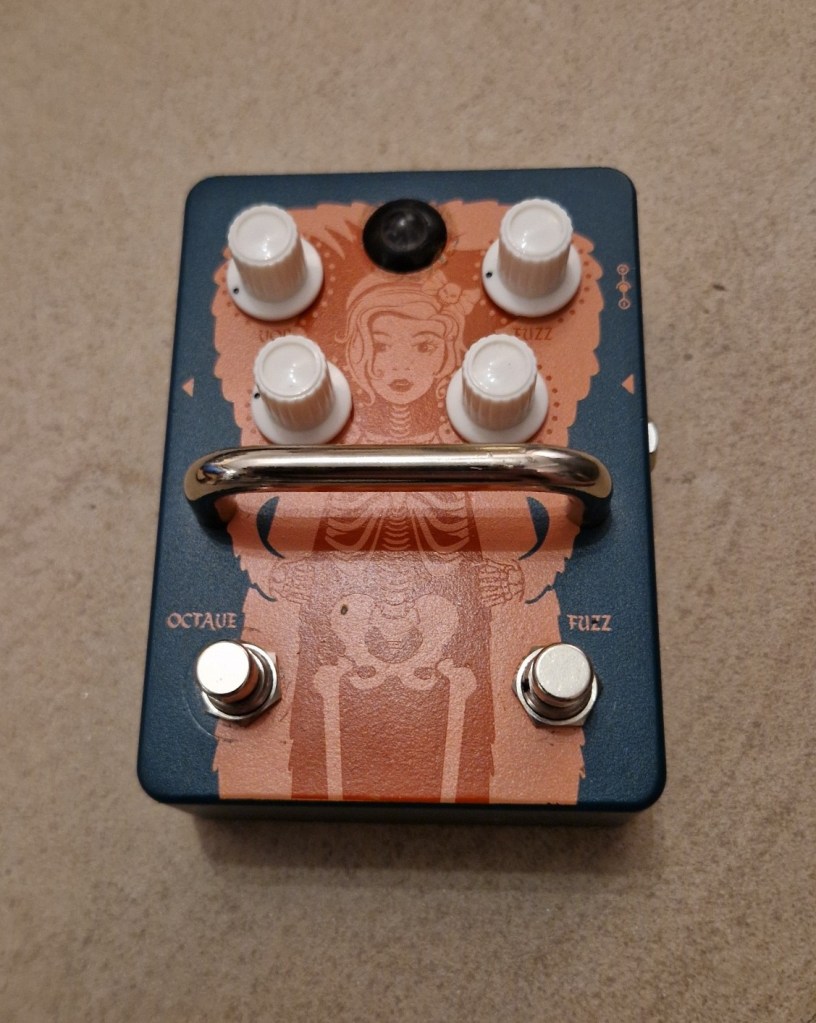
The pedal is housed in a beautiful looking box with nice graphics enhancing the title fur coat. In and output are on the side both of the audio as well as the power. The pedal can be powered with a 9 – 12V power supply or a battery. The pedal draws very little power from this. A bit chrome metal bar is covering the pedal making hitting the knobs while playing a lot harder.
The effect can be adjusted by gain (‘Fuzz’), EQ of the output signal (‘EQ’), the amount of octave when switched on (‘Octave’) and the output volume of the fuzz effect (‘Vol’). Two footswitches function to turn the fuzz effect on and off (‘Fuzz’) and one to turn the Octave effect on and off (‘Octave’). By turning the effect on a big blue LED is lit; when the octave effect is turned on a small(er) red LED also engages.
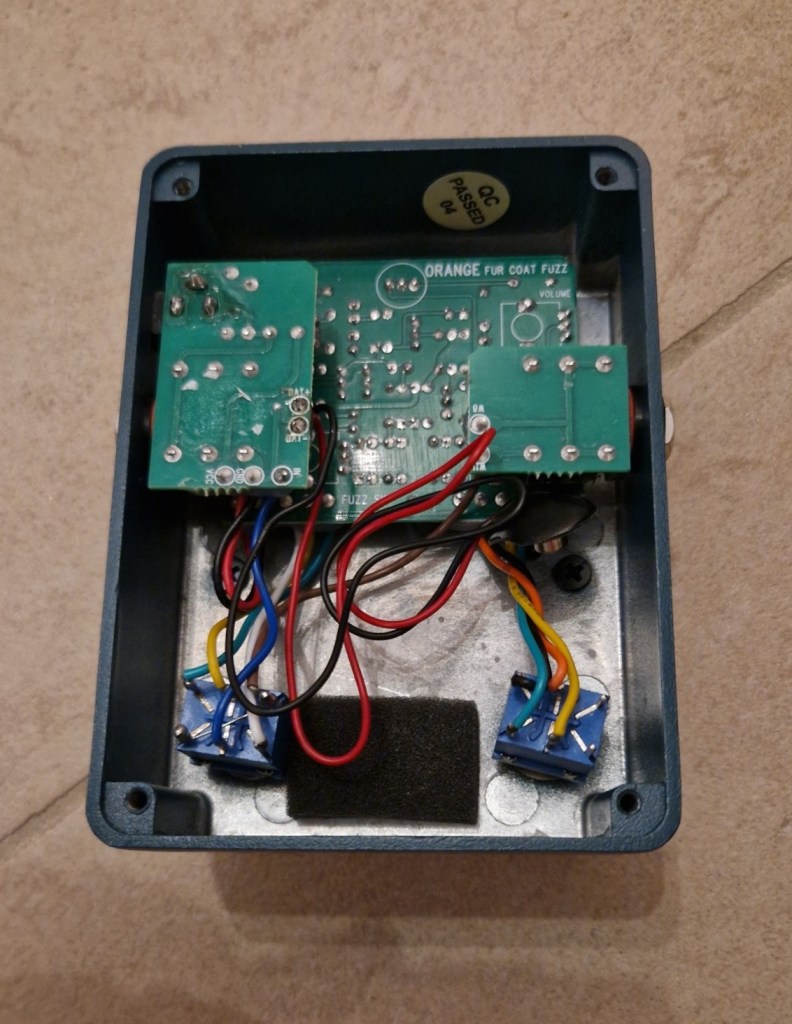
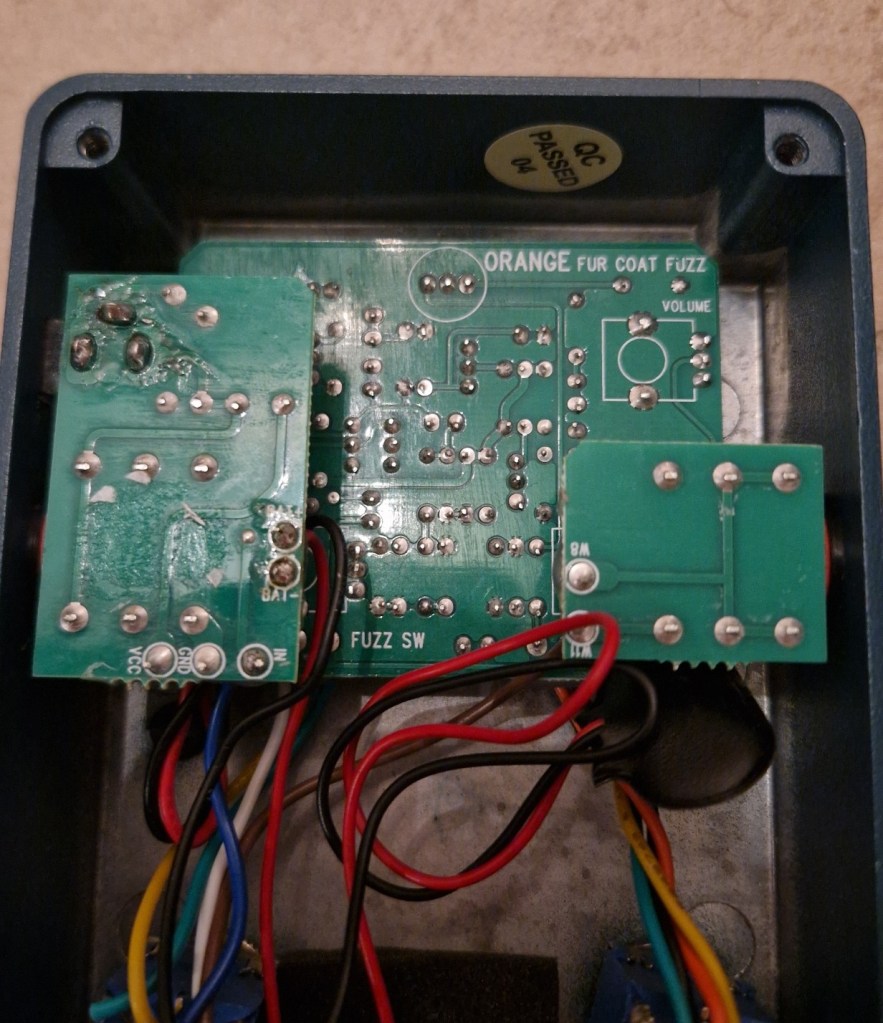
If you open the pedal you spot a dedicated PCB with no SMD but filled with through-hole parts in resistors, capacitors, transistors and diodes. Big sturdy cables connect the main PCB with the smaller In / output PCB’s. The pedal uses quality DPDT footswitches. I decided to trace the pedal.
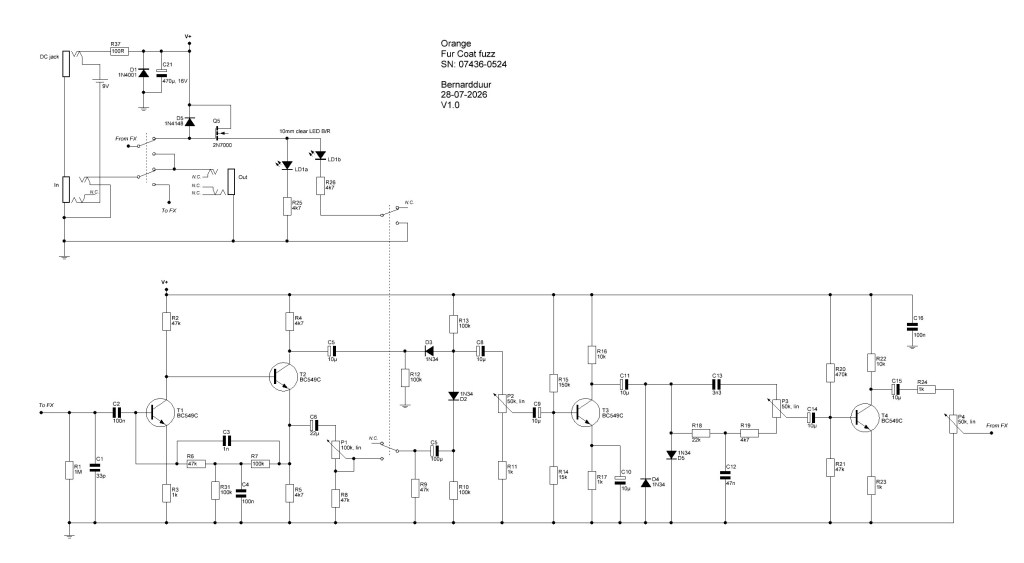
As you can spot the pedal follows the basic fOXX Tone Machine schematic as can be found here. The biggest differences are the choice of transistors and the added control to the octave circuit.
As you can spot this pedal is true bypass and uses a millennium bypass circuit to control the LED. This is a good and quality way to use the more common DPDT for a complex function as pedal and LED switching. You can read more on the Millennium bypass here.
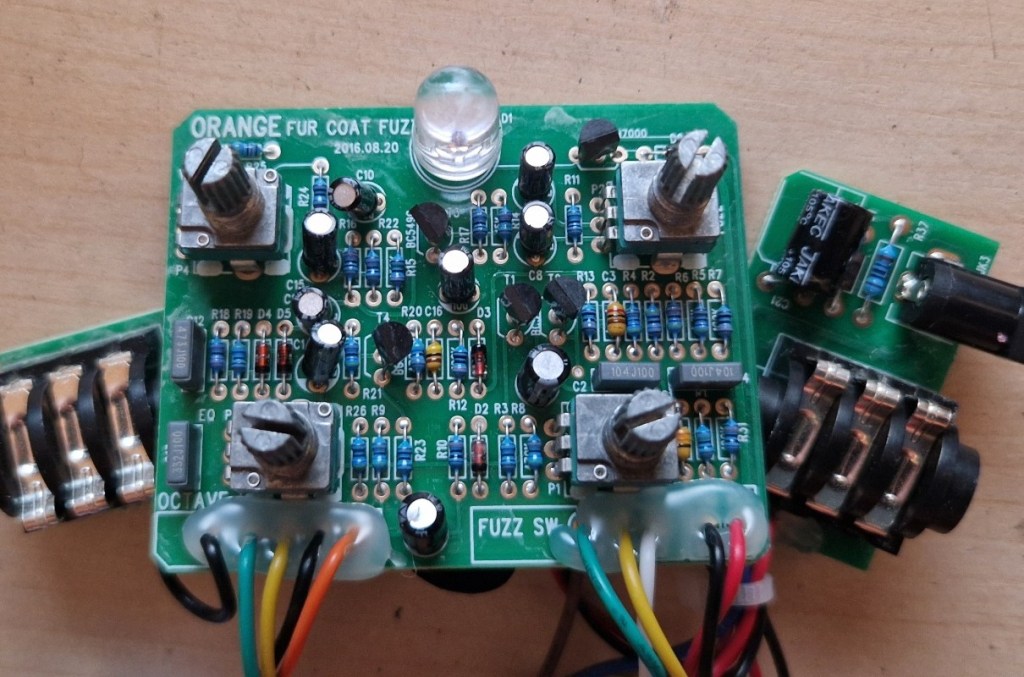
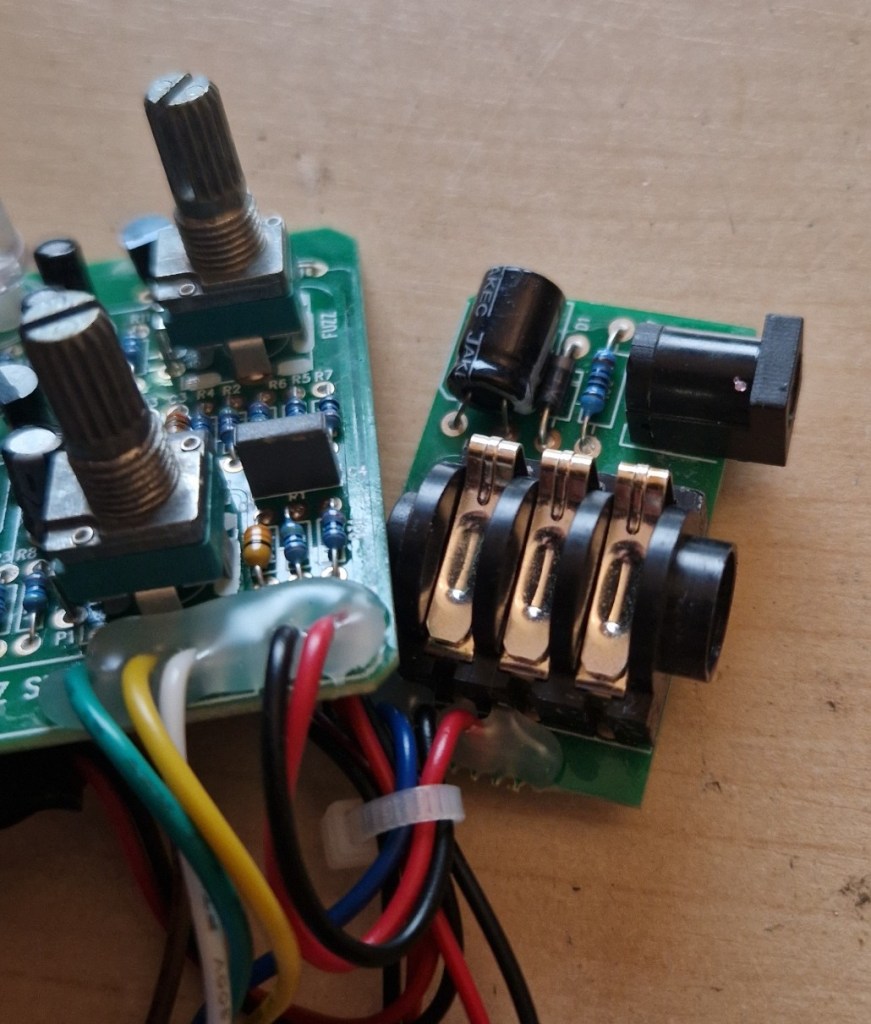
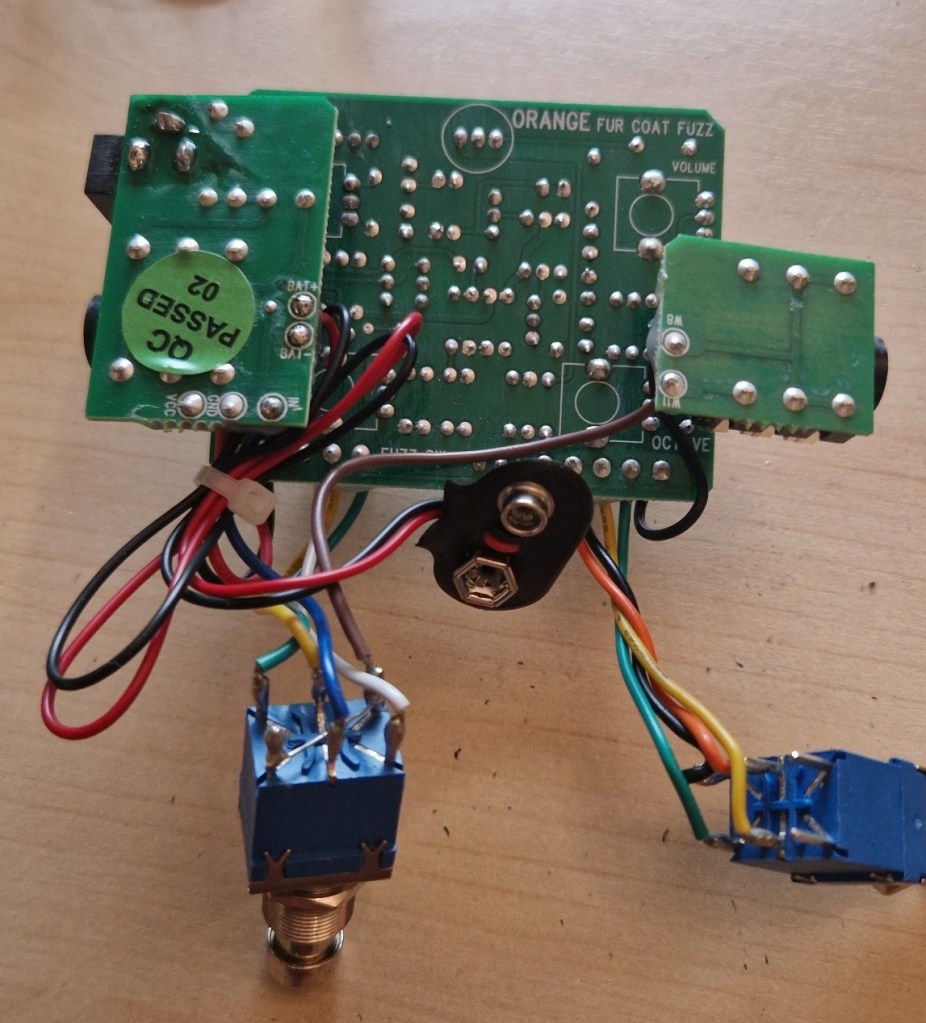
The mods
As this is the first fOXX Tone Machine pedal I write about I will add these mods on this location. These mods can also be done to other fOXX Tone Machine clones.
- Transistor mod: This pedal uses BC549C transistors, a beautiful low noise modern gain transistor. You can swap these transistors with different kind of transistors and find what the effect is on the sound.
- The original 2N3565 will make it more authentic but would change little in the fuzz sound. Maybe a bit more noise is added;
- Lower hFe transistors will do wonders in this build and will lower gain / lower fuzz effect and will shift the emphasis more to the lower mids. I’ve had good experience with BC549A’s but my own favorite is the BC140 (these transistors are bigger and will not fit the place of the BC549C).
- Diode mod 1: part of the sound of the fuzz effect is made with clipping diodes D4 and D5. In this pedal these are germanium (1N34). You can swap them for silicon diodes (less clipping, less compression) to even no clipping at all.
- Diode mod 2: the passing of the signal through the diodes in the octave circuit changes the feeling / flow of the audio signal. In the past I experimented with Schottky diodes (even lower forward voltage compared to Germanium diodes) to get a more natural blooming fuzz sound compared to the stock sounds.
- EQ mod 1: C.. in this pedal functions as a high-pass filter. By adjusting this value down you receive more high end in the CW position of the EQ knob. Enlarging this value adds more mids frequency to this position.
- EQ Mod 2: R.. and C.. function as a low-pass filter. By enlarging the capacitor value or decreasing the resistance you lower the frequency this filter acts on. Stock it is set at 154 Hz (CCW position).
- Gain mod: by removing C.. from the PCB you reduce the gain of T.. This way the pedal has lesser gain and will sound more tame. It will also change the frequency response of transistor stage T.. so it will also change how the pedal will sound.
The sounds
I love this effect! I’ve always been a big fan of the original fOXX Tone Machine and I can compare any clone with an original. I also spend some time building clones for other people.
This pedal is that and even more. Because it adds that low noise high gainy fuzz sounds with ease that comes close to the original, but the addition of the second footswitch (the original fOXX had a rocker switch to add the octave) and that Octave knob makes it even perfect! The newly added Octave knob gives you perfect control over the octave effect. Many people claim this knob only functions in the latter 10% of the turn, but I noticed that this function was responding to the amount of gain set, the location on the neck you are playing, which pickup you are using and the output of the pickup or the guitar.
Then I switched to bass and boy, was I surprised. Because the original fOXX works well on a bass guitar but this pedal does even more then that! I favor the lower gained fuzz sounds of this pedal where the articulation is still available but the fuzz effect is nice and piercing. Setting the EQ low gives enough low end to focus through the mix and still be apparent in that same mix. With the octave function activated the bass effect gets more and more aware in the mix. And with the added octave knob you can set the amount of octave perfectly between all-out fuzzy goodness or just that hint to make you heard more. A winner!
The links


Leave a comment