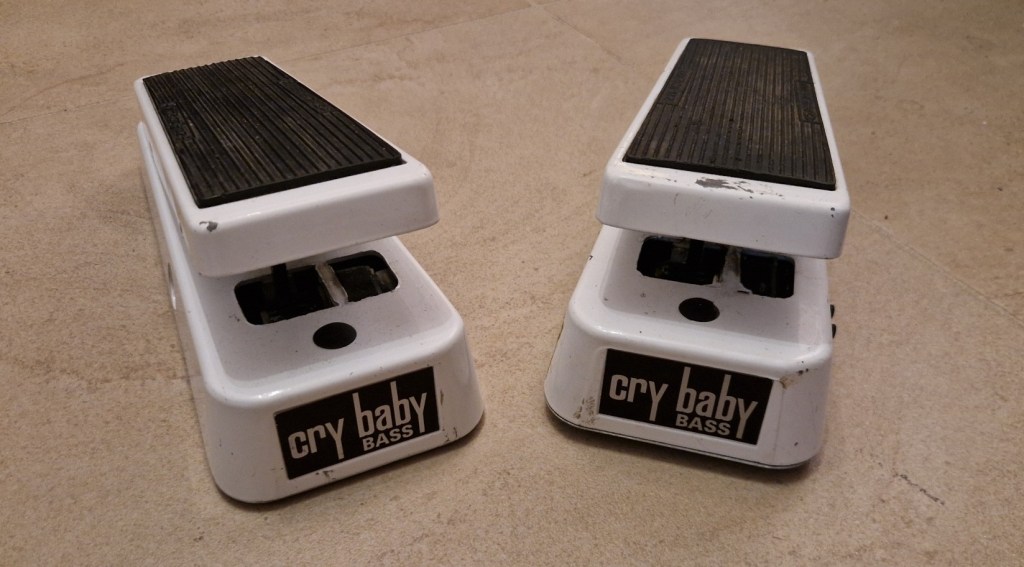
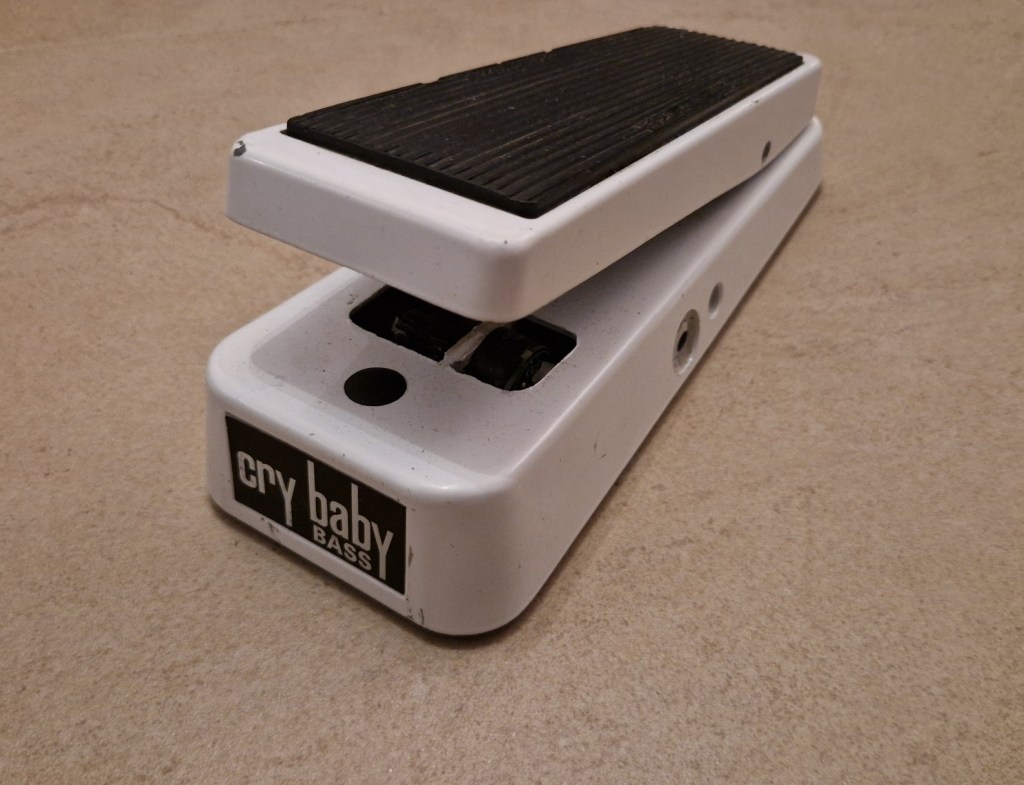
This white beast is quite common on bass’ pedalboards; I traced mine a while ago! Let share some info!
The wah effect is a quite common effect on most guitar players pedalboard. The standard wah, although not fitting the bass frequencies well, could also be seen on various bass pedalboards (NIB anyone??). Dunlop got hold of the name Crybaby in 1982 as Thomas Organ, the original owner of the name crybaby, did not trademark the name. As this range focused mainly on guitars it took some time to develop a wah suitable for bass. Morley and Dunlop, two main players in wah pedals tried.
Morley developed the Tel Ray pedals in the 70’s that had an extended wah range (both up and down) so it would fit both guitar and bass. In the end this pedal worked for both but needed a lot of attention and focus not to overstep the range. Yet players used it to their extend (Cliff Burton was a well known user). Later, in the 90’s, Morley developed the Morley PB (Pro Bass, the blue pedal) and the PBII (dual bass) as their main competitors on the market. These pedals have a great following and do sound like nothing else, yet are limited to the low end ‘wah’ sound and tend to make the sound a bit muddy.
Dunlop developed the GCB100 in the 90’s; this modified classic wah circuit was a step up from the guitars version and yet again, not what bass players wanted. Because this pedal also was also limited to the low end wah and had a tendency to muddy up the sound. In 1999 though Dunlop released the 105Q: a new design wah pedal that’d filter the mid and high frequencies but leave the lower notes intact. This pedal became the standard wah effect pedals for bass players as it has a broad spectrum, easy to use function and a great sound. Two versions were released: the older version with through hole components and one with SMD components.
The circuit
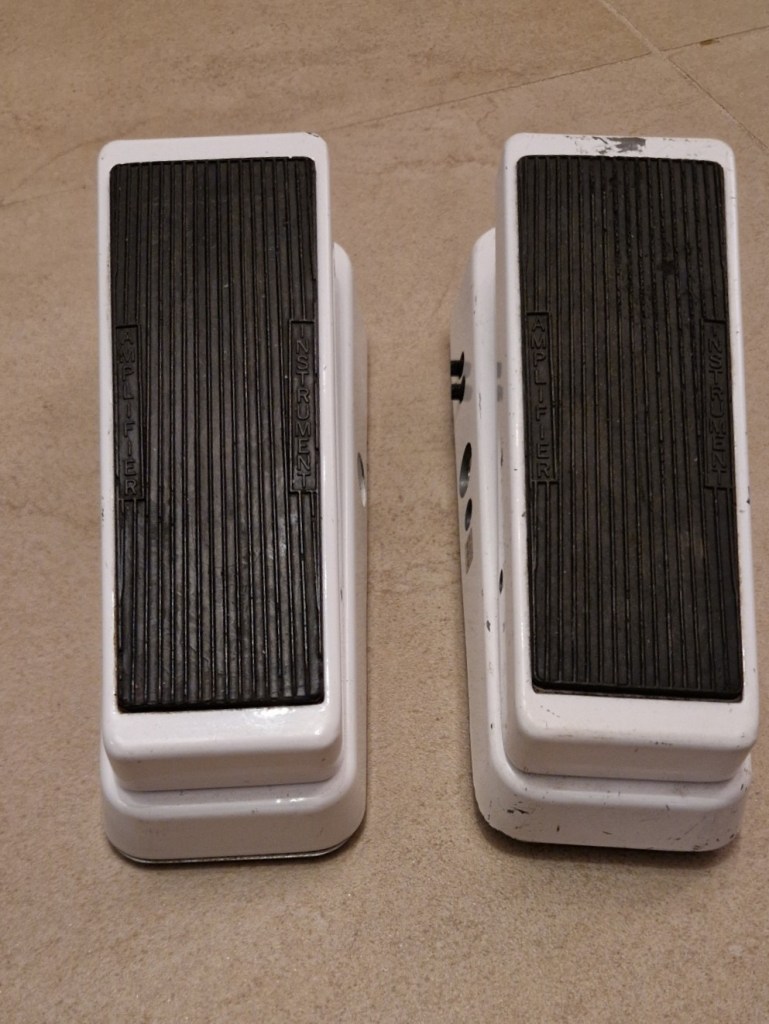
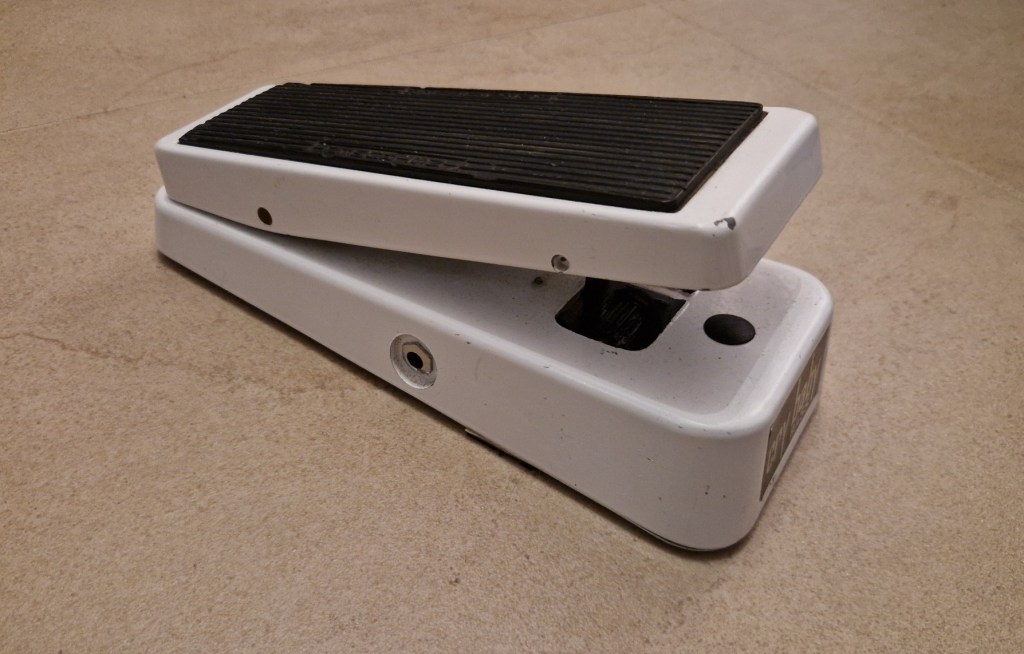
Housed in a beautiful white enclosure this wah is a read eye catcher. It is modelled after the other Crybaby Wah’s in size and looks. The 105Q features an auto on function that engages the pedal when it is pressed slightly. In the ‘Off’ position the wah is in the full-heel position. A spring pushes the treadle back to this position when not in use. Switching is done with a mini switch underneath the heel side of the effect. In the later versions the time between switching can be adjusted by an internal trimpot.
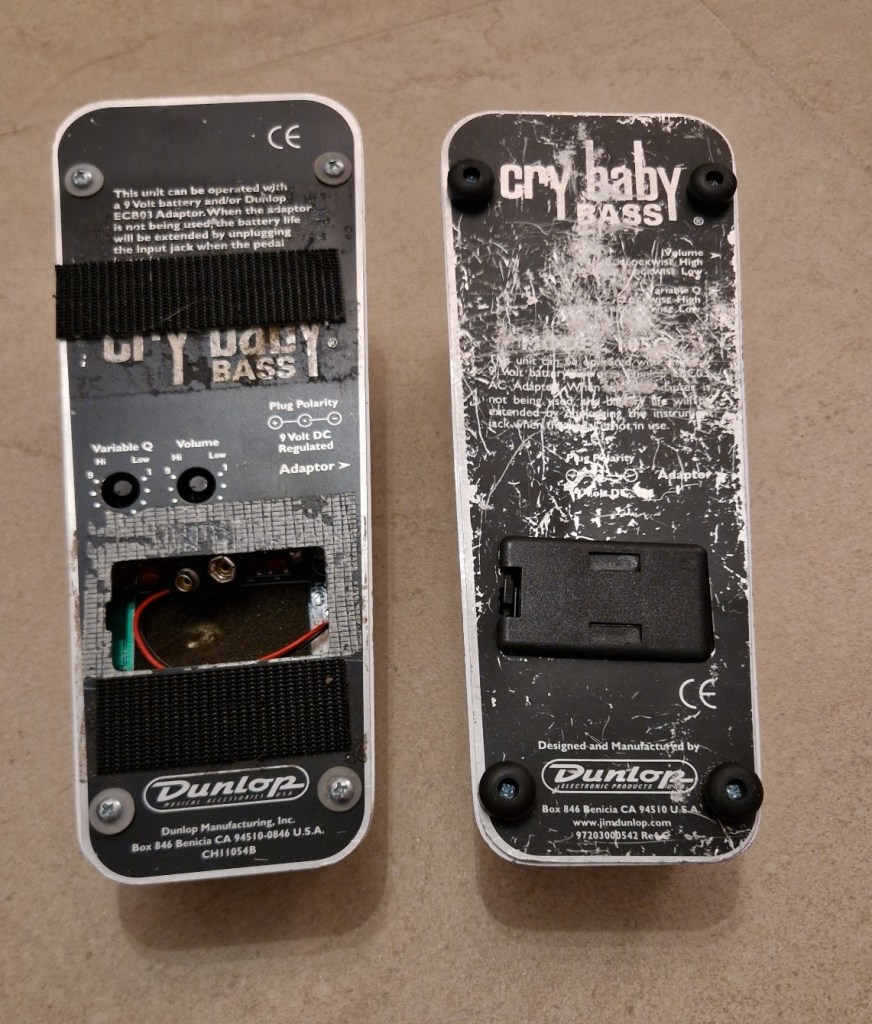
On both models two adjustments can be made by external potmeters. Yet the location of these potmeter is diferent:
- In the first (through hole components) edition these trimpots are located underneath the effect making adjustments hard when the pedal is placed on a pedalboard;
- In the later versions these two potmeters are placed to the side of the pedal.
These knobs control the sharpness of the filter (‘Q’) and the output level of the effect (‘Volume’). The wah effect/ filter is determined by the location of the treadle: in the toe-down position the filter is set to pass the high end, in the heel-down position the filter passes the low end (ie the wah effect).
Two versions are available:
- The first produced version had bigger, through hole components
- The second edition was made with SMD components.
First version: PCB code CH06001H 12-08-98 / EH06001H
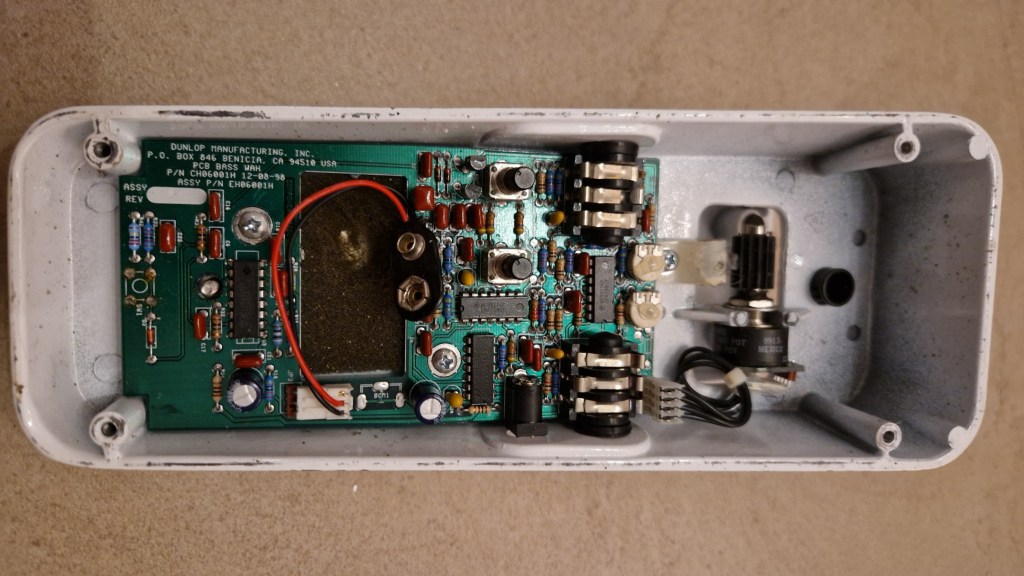
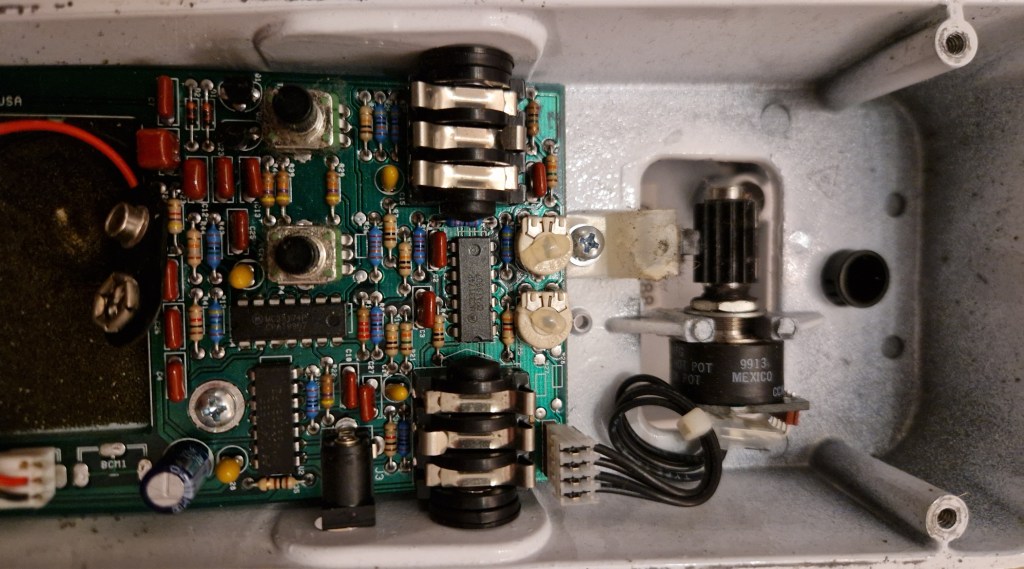
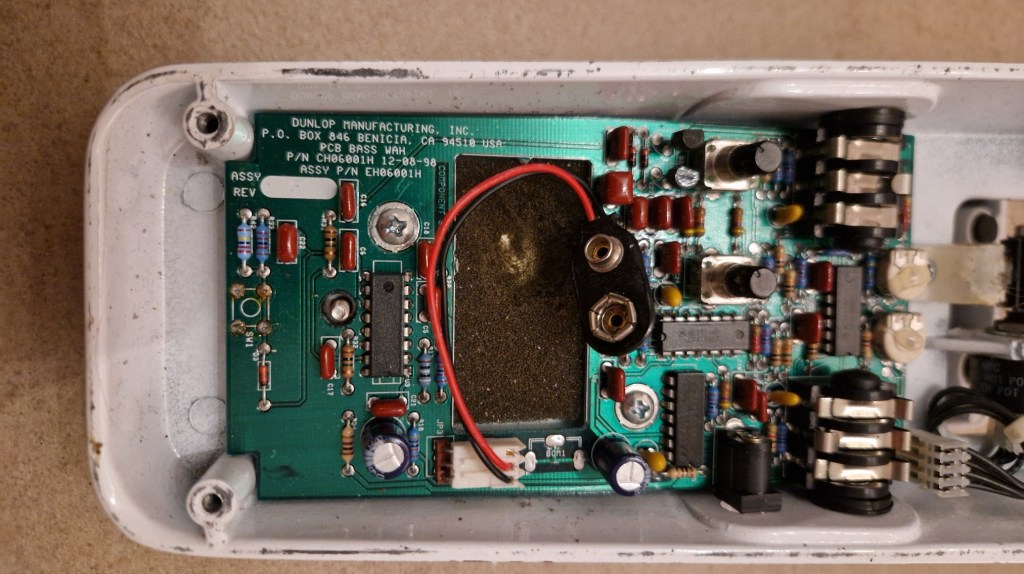
And the schematic:
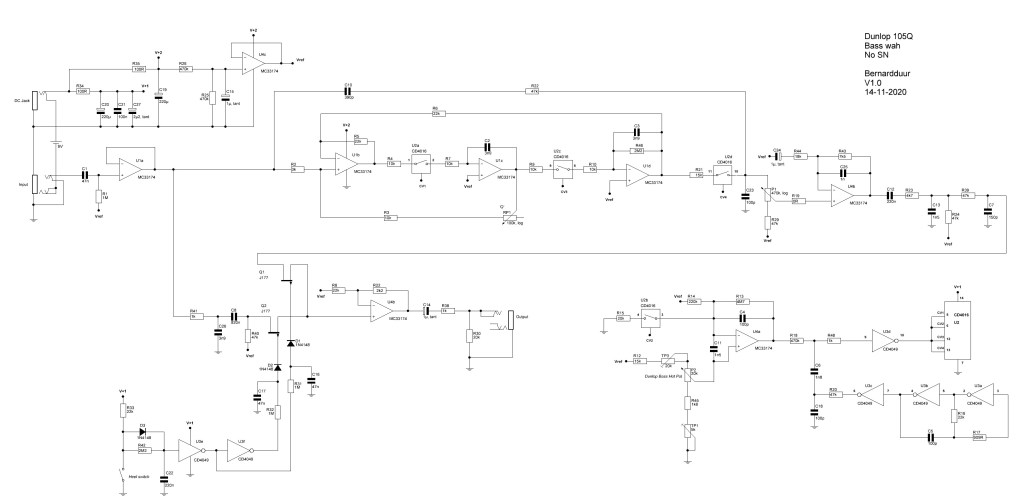
Second version: PCB code 93503000056 02-11-2001 Rev E
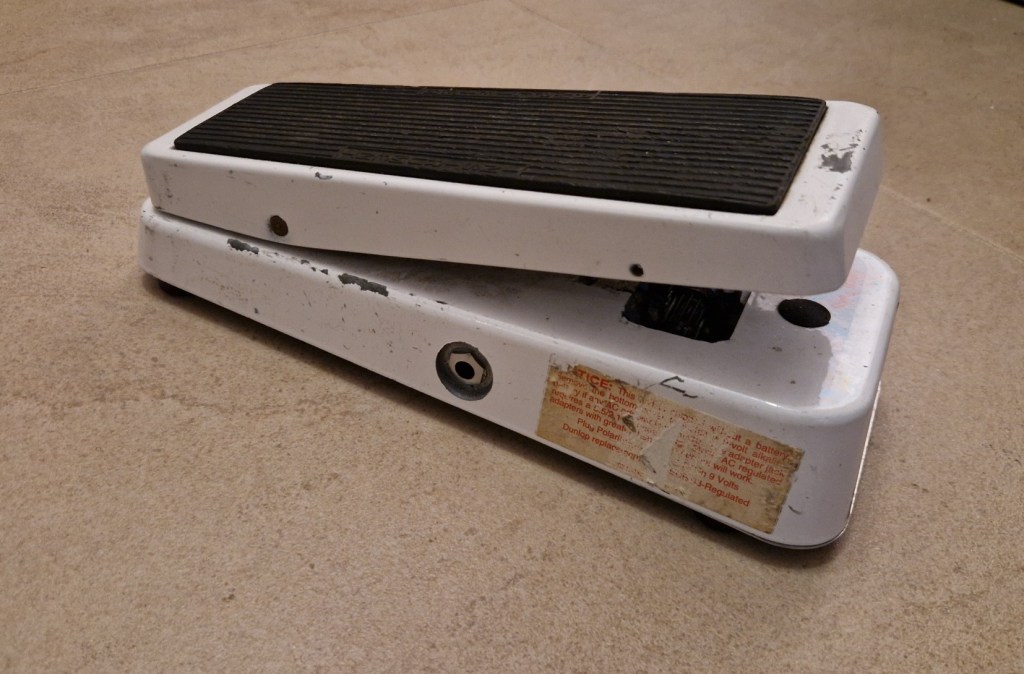
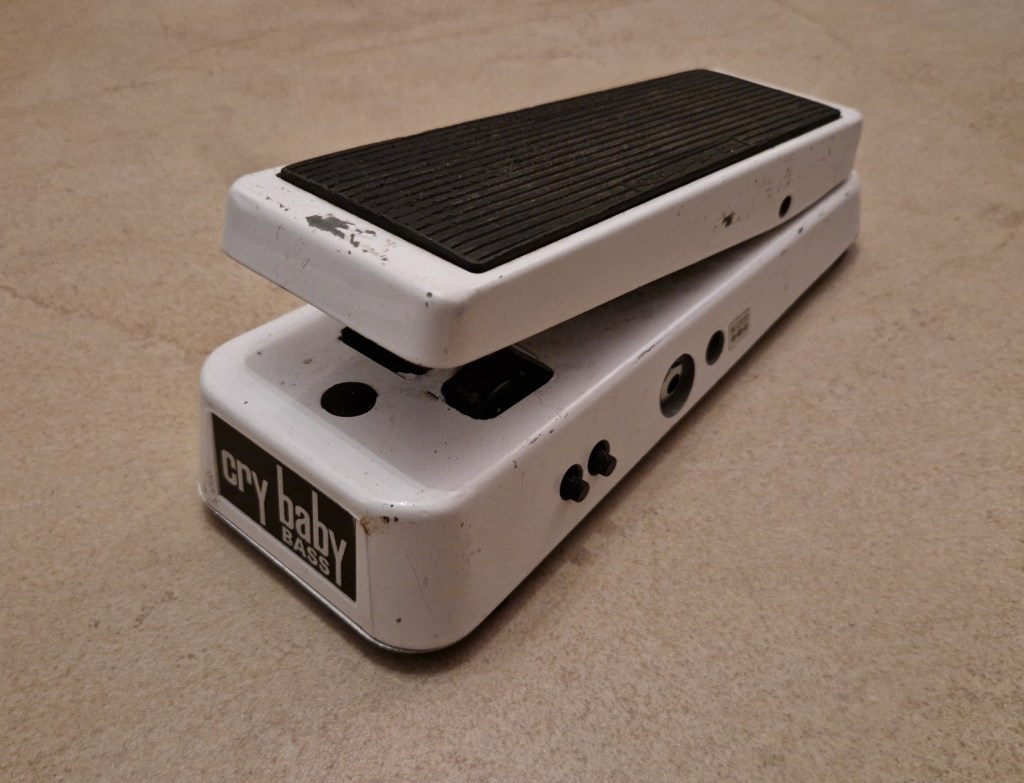
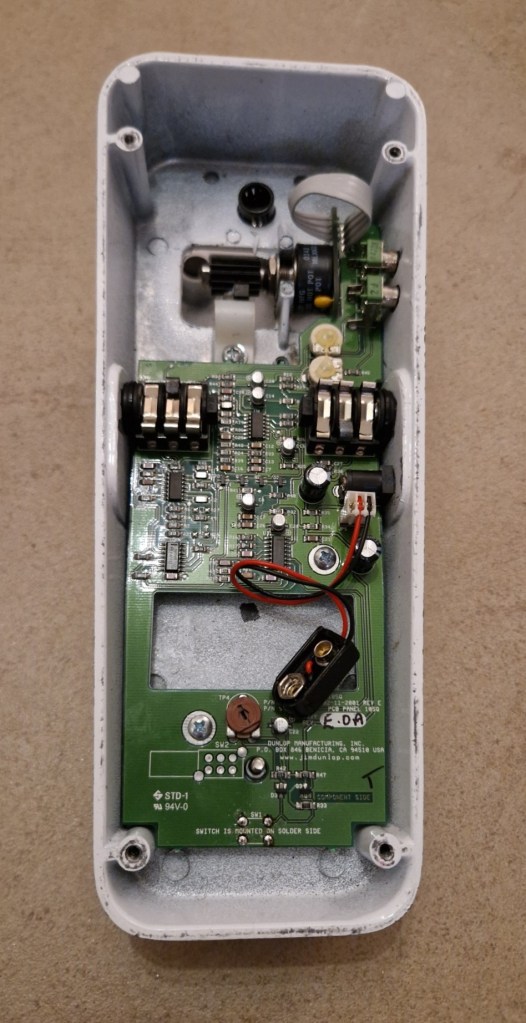
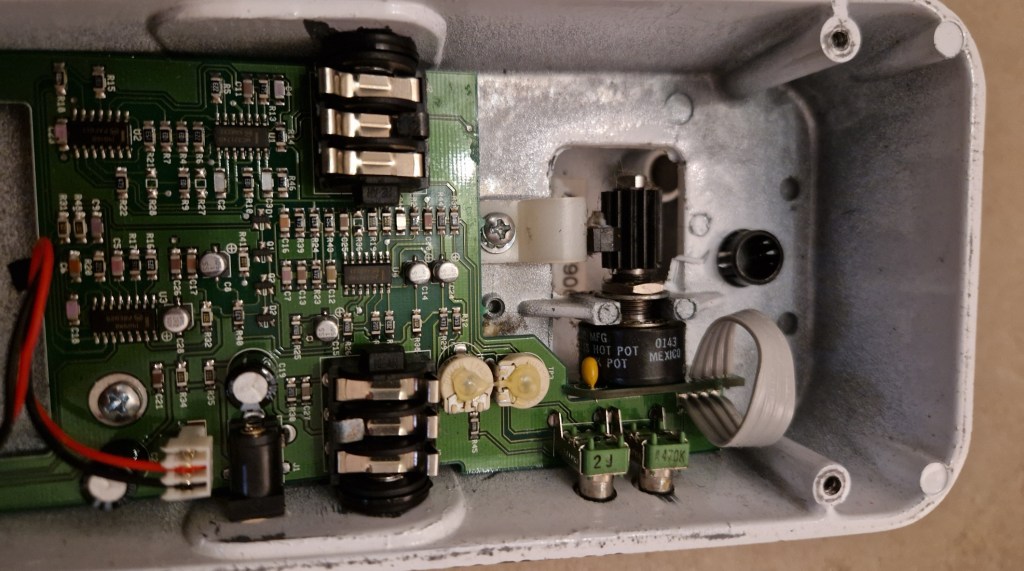
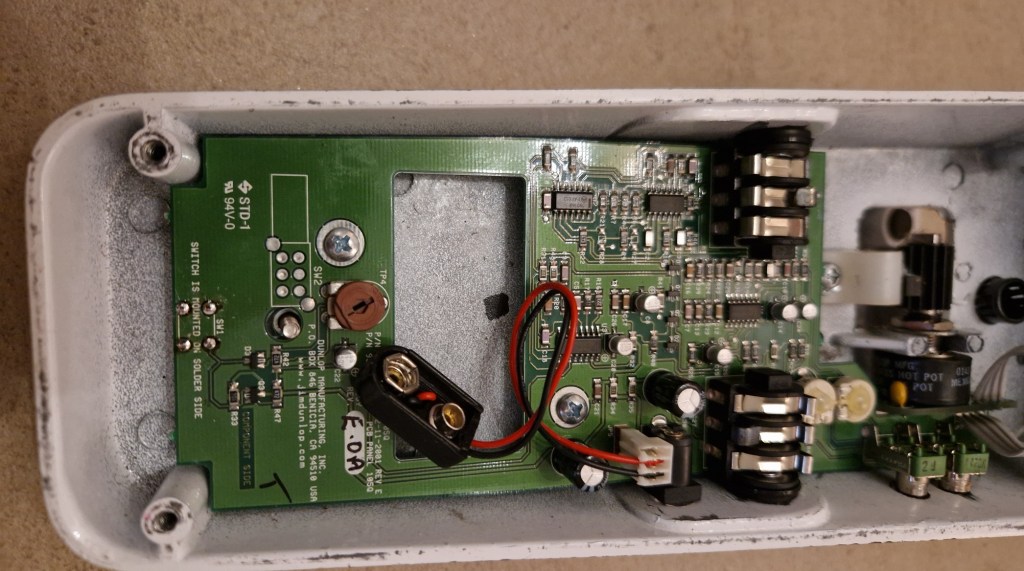
And the schematic:
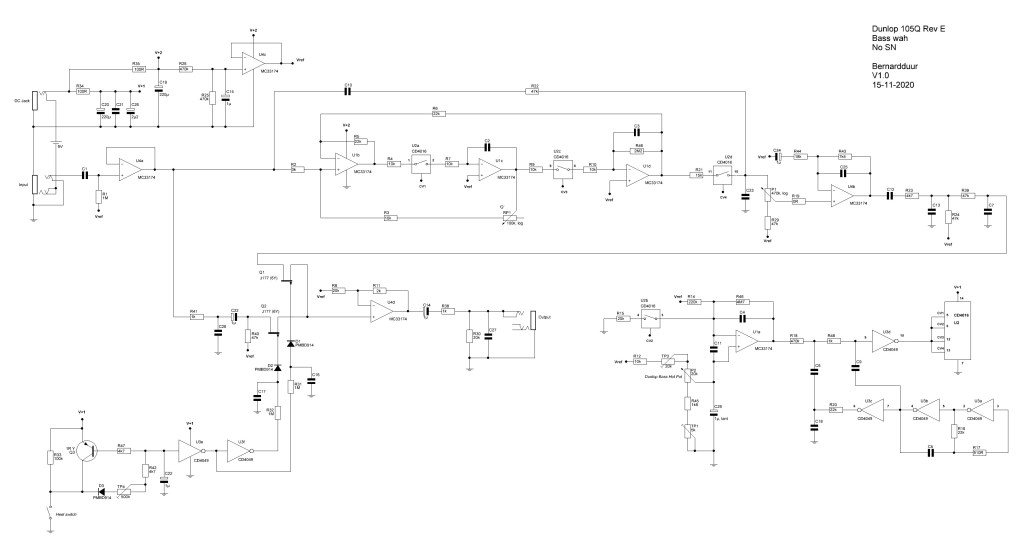
Both schematics are close to each other. The second version had SMD caps and not all caps could be measured in the circuit. I think you can swap the values for the ones in the original schematic.
As you can spot in the schematic this pedal is an MXR Envelope Filter where the envelope detector is replaced by a treadle. This way you can control the effect with your foot. This envelope filter is a low pass filter that works well with basses thus giving credit to Dunlop on the choice of circuit as the basis of this pedal.
The mods
Most of the mods on the MXR envelope filter can be done to this pedal.
- The range of the effect is determined by the position of the potmeter. As the range of the treadle is limited, alterations to the potmeter determine the middle setting of the effect. You can adjust the potmeter by releasing the piece of plastic behind the geared plastic beam and adjust the potmeter up or down. This way you can find the sounds more fitting your style. Please note the resistance setting on the potmeter making sure you can find the sweet spot back Dunlop selected for you.
The sound
This pedal simply rocks! While envelope filters are glued to bass guitar players (mostly in funk music) this pedal takes this effect into a whole new range. Where the standard envelope filters were limited to the dynamics of your playing style this pedal can be controlled to make even more interesting sounds a standard envelope filter is not capable of.
As a known low pass filter it leaves the low end intact but plays with the mids and higher frequencies in a very music way. The range of the pedal follows the range of the bass guitar and the way the circuit is made it doesn’t muddy the signal in the heel-down position or cuts most bass in the toe-down position. Yet it accentuates the fundamentals of the bass guitar while playing with the harmonies above it. It works very well together with overdrive or fuzz pedals but the effect is determined by the place it is located in the chain:
- Placed before the gain pedals the effect works more like a traditional wah effect giving more emphasis to certain notes making them push through the mix perfectly.
- Placed after the gain pedals the effect works more like a traditional filter effect controlling the whole audio band; at this position the effect is much more potent in adjusting the whole EQ of the sound.
Listening to these two pedals side by side no real winner could be found. Both pedals work perfectly well combined with a good bass amp. Between the two I found the first version to have a better bypass tone, yet differences are small!
The effect is noise free. There is little to no colouration of the bypass sound. The auto-on feature is a great addition to the effect but requires some time to get used to in both starting the pedal as well as bypassing it.
In this form this pedal is a very versatile effect for bass players searching for a decent filter to use in songs. Yet, although it comes close, a decent wah effect it is not. We can easily question ourself if that is what is needed or wanted, as a wah effect has a totally different function in the music. My personal opinion is that this pedal surpasses the traditional wah effect and delivers so much more for bass players! A clear winner!!
Links
 Homepage
Leave a comment