This pedal ventured on my path. As I already got to know these Dr. J pedals as being clones of other pedals, I wondered what this pedal would be! Let’s dig in!
Dr. J pedals were brought to life by Dee Leung, a Chinese musician who like to fiddle with guitar pedals to understand what made these pedals tick! Most people saw him as a modding freak, a pedal head or pedal geek, a relative introvert kind of guy. He even designed an overdrive pedal that he gave his friends for all the support they gave him over the years.
One of the earlier users of these pedals were of the founders of Joyo, a well known Chinese brand of pedals. Joyo assisted with the start-up of the Dr. J line of pedals and even designed the name of the brand: Dr. J, named after Jimi Hendrix. This name implied that every Dr. J pedal embodies Jimi’s unconstrained creativity. Their official website is down (and can only be viewed through the Way Back Machine) but Joyo has some space on their website for this brand.
On the Dr. J Planes Walker fuzz pedal no comments are made on the origins of the pedal, only that is falls between an overdrive and distortion pedal and that it is not a high gain fuzz. A manual is not available.
The circuit
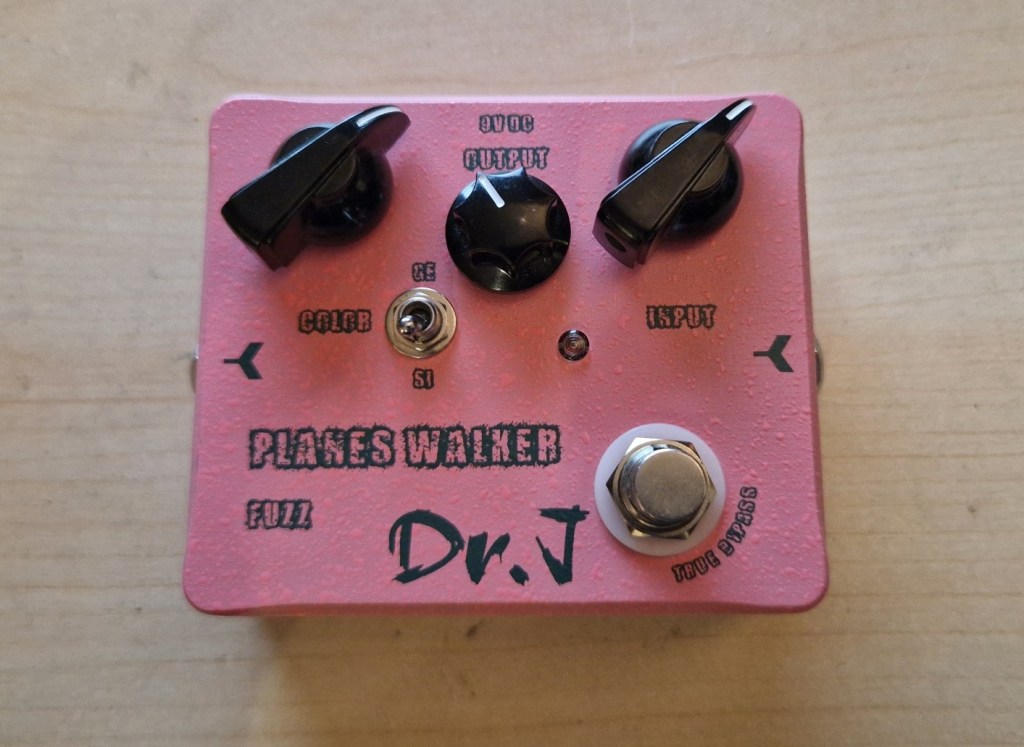
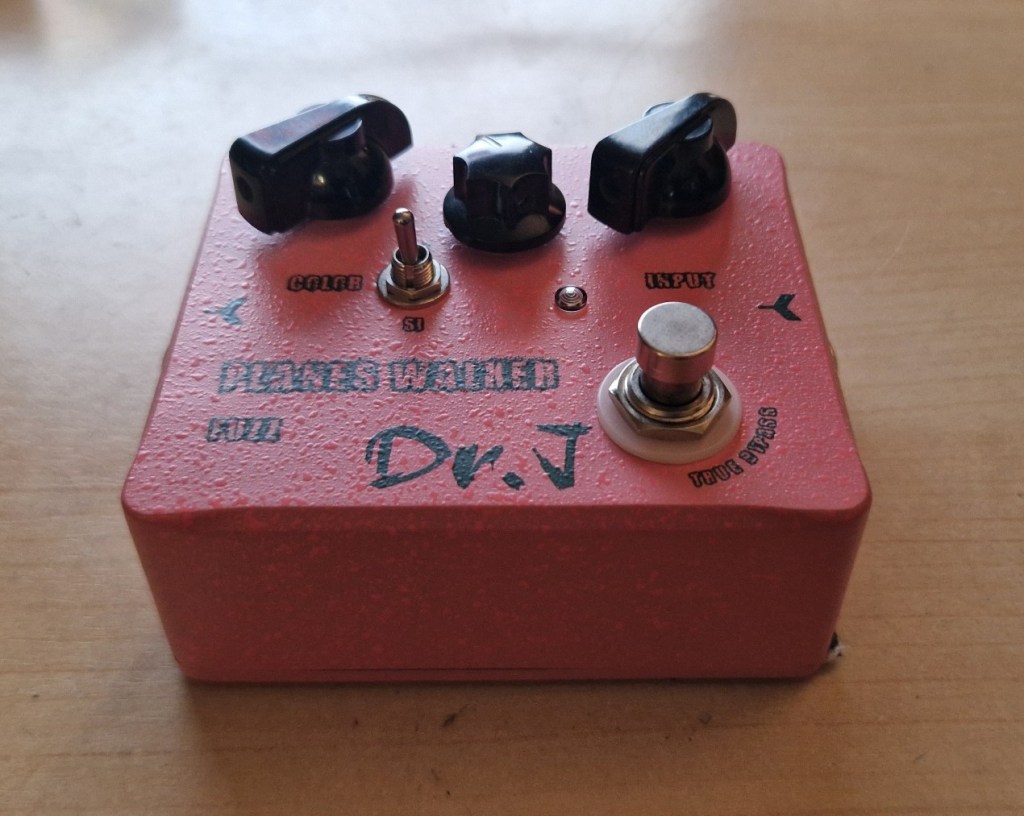
The pedal is housed in a somewhat high, all aluminium, pedal enclosure. All the Dr. J pedals are housed in this same enclosure, just the colours vary. For the Planes Walker Fuzz they’ve chosen the pink enclosure.
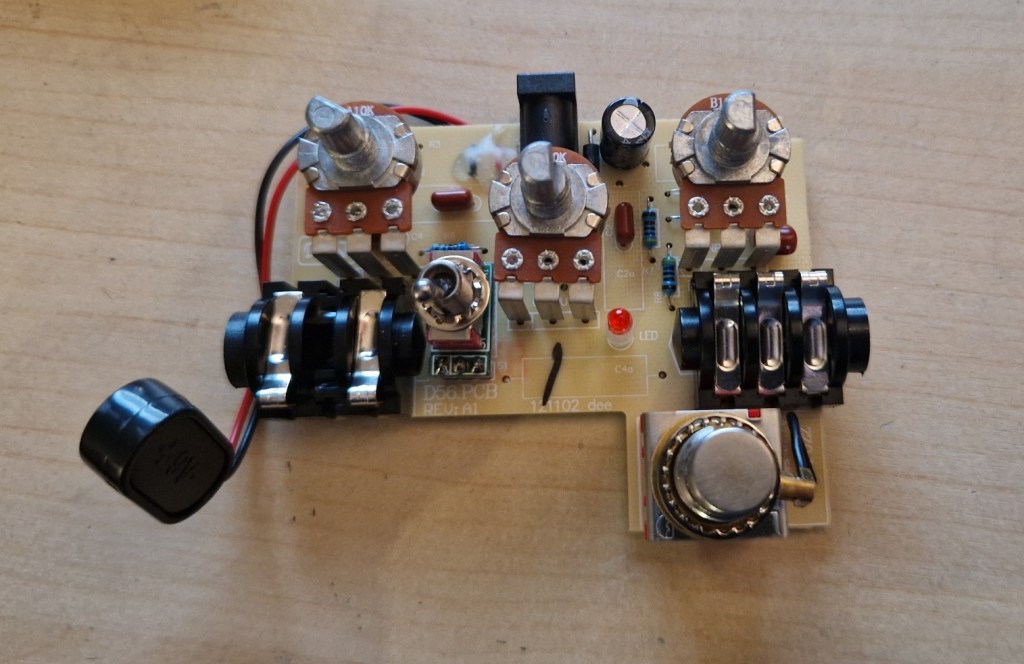
The pedal has three knobs. The input and output are on the side of the pedal and the power input (can also be powered by a 9V battery) can be found on the top of the pedal. A single footswitch engages the pedal and internally the pedal is wired up to be true bypass. The effect has knobs for gain (‘Input’), Tone (‘Color’) and output volume (‘Output’). It has a switch to choose between Silicon and Germanium diodes.
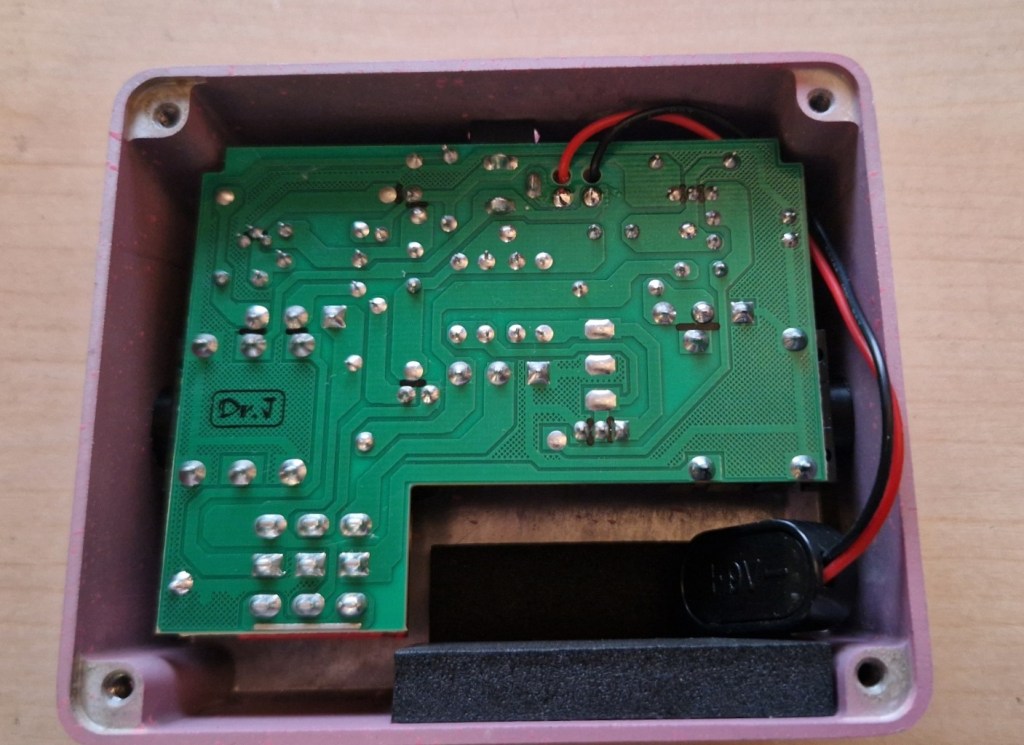
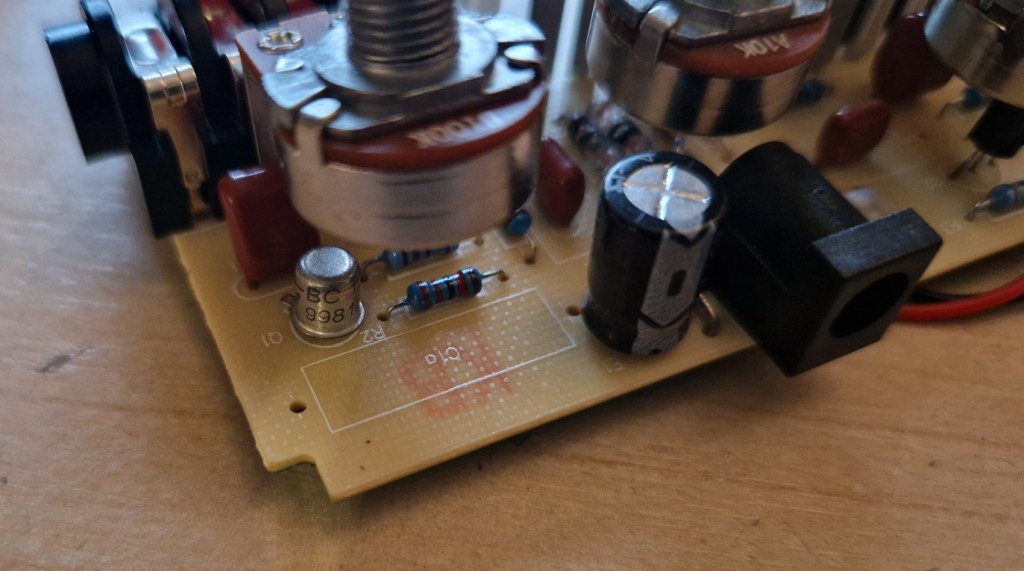
Internally the pedal’s circuit is housed on a single PCB that is housed by big, through hole, parts. You can even spot that every ‘modest sized’ cap can be replaced by ‘Big Boutique Caps’ as all cap positions have a ‘A’ position that has a larger footprint. With this you can also add a second cap parallel to the first. As I was interested in what this pedal is a clone of, I traced it.
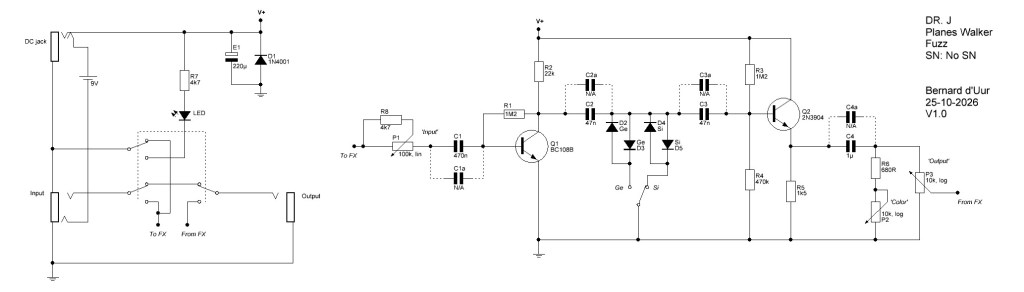
As you can spot this pedal is a close clone of a rare fuzz pedal called the ‘Astro tone fuzz‘ or ‘Sam Ash fuzz boxx‘ both made and designed by the 1966 company Astro amp. The original pedals used different kind of transistors and the team of Dr. J added some mods (input and output cap, etc). This post on Analogman’s website gives some more info on the Astrotone fuzz. In this post on Freestompboxes.org the Astrotone Fuzz is discussed (with schematic).
The sound
Shame I have no original Astrotone fuzz laying around but I’d guess this pedal will sound like a different kind of fuzz. And although I know that, this pedal does something really good!
Yes, I’d agree that it is a quite low gained fuzz pedals that works more like an overdrive pedal then a distortion pedal. The overall sound yet is quite fuzzy so it definitely deserves the fuzz title. But this pedal does something extra: it adds that slight overdrive fuzz sounds in the hands of the player that merges well with most guitars and lets you add a touch of dynamics and volume controlled overdrive. Rolling back the volume knob does so much on this unit. And the choice of diodes does something extra: it changes the character of that fuzz. With the silicon selected the overall gain of the pedal drops and it stays clean much longer. Rolling back the volume gives you a decent clean sound. With the germanium selected the pedal goes into clipping territory much earlier and also rolling back the volume gives you still a hint of overdrive.
The ‘Input‘ control adds a lot of control on the gain of the pedal changing between a low-gain-ish fuzz that works wonders with chords up to higher gained fuzz tones that still works well with chords. The ‘Color‘ knob lowers the amount of low end in the sound; putting it on full gives you the full low end! I enjoyed this pedal with both guitars and bass’, yet this pedal has a tad too little low end to make it work perfect with the bass guitar!
A somewhat different fuzz box that doesn’t let you riff out but one that makes sure you can add some nice chords to it! And that can be enough!
Links
- Original website of Dr. J pedals (only to be viewed through the waybackmachine.
- Space on the Joyo website on this pedal
- Post on Analogman’s website on the Astrotone Fuzz
- Post on Freestomboxes.org on the Astrotone Fuzz


Leave a Reply